Winter-Proof Mudroom Design Ideas for Canadian Homes
Design a mudroom that handles Canadian winters. Heated floors, boot storage, drainage solutions, and material choices that survive salt, slush, and -30°C.
Georgia Home Design
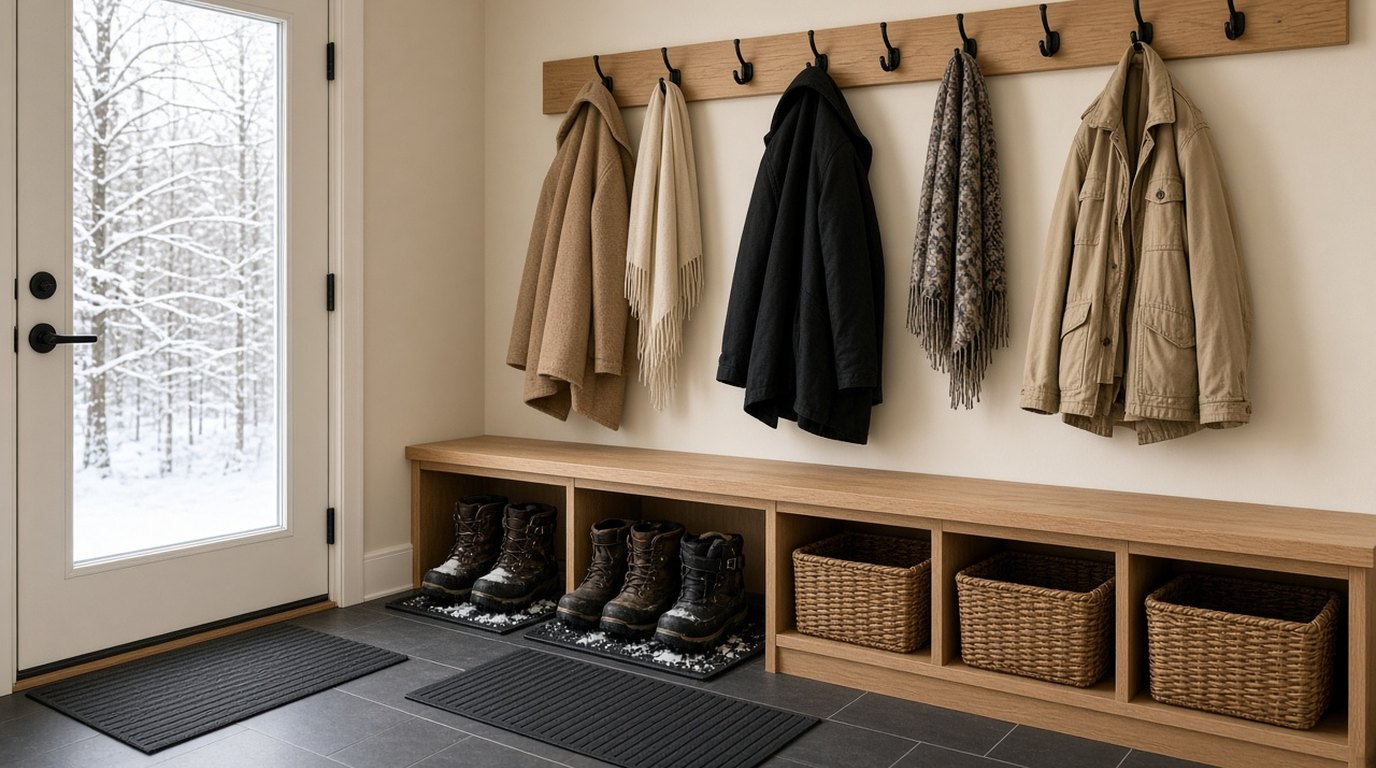
A mudroom in Vancouver is a nice-to-have. A mudroom in Winnipeg, Calgary, or Ottawa is survival infrastructure. When you’re dealing with six months of snow, ice melt tracked in on boots, parkas dripping with slush, and the daily ritual of layering and de-layering for -30°C, a well-designed mudroom is the difference between a functional home and a perpetually damp, chaotic entryway.
I’ve designed mudrooms across the prairies and I’ll be blunt: most builders treat them as an afterthought. A 4x4 tiled square by the side door with a single coat hook. That doesn’t cut it when a family of four comes home from skating with wet snow pants, soaked mittens, and boots caked in calcium chloride.
This guide covers how to design a mudroom that actually works for Canadian winters, from layout and flooring to storage systems and drainage. Lamps, rugs, and January colour live in winter-proof interior design. The regret of skipping this room while the kitchen was open is in cold-climate renovation regrets.
This is planning advice from Georgia Home Design, not a lab test and not a priced bid. Cost bands below are research ranges, not a quote.
If you are listing, buyers judge the house at the door they use. Winnipeg home staging is the occupied-house version of that first minute. If the side door dumps into the kitchen, do not run a delicate floor to the island. See kitchen renovation ideas for Winnipeg. A half-flight down is a basement landing; keep it dry before you finish the lounge (basement renovation in Winnipeg). Entry paint should wipe; colour names are on best paint colours for small Canadian homes.
Why Canadian Homes Need a Real Mudroom
In warmer climates, the front door opens into a foyer. You step inside, kick off your shoes, and you’re done. In a Canadian winter, arriving home involves:
- Stamping snow off boots
- Removing boots (which are wet and salt-crusted)
- Hanging up a parka, scarf, hat, and gloves (all of which are damp)
- Peeling off snow pants (if you have kids, multiply this by the number of children)
- Stashing toques, neck warmers, and ski goggles
- Storing the dog’s leash, paw-cleaning supplies, and towels
All of this generates moisture. A lot of it. Without a proper mudroom, that moisture migrates into your home. Wet boots on the kitchen floor. Parkas draped over dining chairs. Puddles forming on hardwood that will eventually warp.
A dedicated mudroom contains this chaos, quite literally. It’s a buffer zone between the Canadian outdoors and your interior living space.
Layout: Getting the Bones Right
Minimum Size
For a family of four in a Canadian climate, aim for a mudroom that’s at least 6 feet by 8 feet. Smaller than that and you’ll be fighting the space every day. If you have the luxury of more square footage, 8 by 10 feet allows for a bench, closed storage, and a proper boot drying area without feeling cramped. Tight leftover landings still need the same sequence (stomp, sit, hang) just stacked. House-wide small-space tactics are small space design tips.
The Ideal Flow
Think of the mudroom as a sequence, not a room. The flow should go:
- Enter - Door with weather stripping and a draft barrier
- Stomp and drain - Boot tray or drain grate directly inside the door
- Sit and remove - Bench for taking off boots and snow pants
- Hang - Hooks and pegs for outerwear at multiple heights
- Store - Closed cabinets or cubbies for items not in daily rotation
- Transition - Clear path to the rest of the home, ideally through a door or archway that visually separates the mudroom from living space
The biggest mistake I see: putting the bench too far from the door. You want the bench within arm’s reach of where you step inside, so you can sit down immediately in wet boots rather than tracking slush across the floor to reach it.
Location in the Home
Side entry (best option). Most Canadian homes have a side or back door from the garage or driveway. Converting this entry into a mudroom makes the most sense because it’s the door the family actually uses daily. The formal front door stays clean for guests.
Garage-to-house transition. If you have an attached garage, the hallway between the garage and the house is prime mudroom territory. It’s already a transition zone, and the garage provides a natural first layer of snow removal.
Basement entry. In many Winnipeg bungalows, the side door opens to a half-flight of stairs down. This is tricky but workable. Durable materials on the stairs, a boot tray at the bottom landing, and hooks along the stairway wall create a vertical mudroom.
For more ideas about entryway design, see our guide on Curb Appeal in Winter.
Flooring: The Most Important Decision
Mudroom flooring in a Canadian home takes more abuse than any other surface in the house. It needs to handle standing water, salt, sand, calcium chloride, freeze-thaw temperature swings, and heavy foot traffic. Here’s what works and what doesn’t.
Porcelain Tile (Top Choice)
Porcelain tile is the gold standard for Canadian mudrooms. It’s waterproof, scratch-resistant, impervious to salt, and easy to clean. Choose a textured or matte finish for slip resistance when wet, glossy porcelain becomes a skating rink when it’s wet.
Key specs:
- PEI rating of 4 or higher (commercial-grade durability)
- Slip resistance coefficient of friction (COF) of 0.60 or higher
- Large format tiles (12x24 or larger) minimize grout lines where moisture can collect
- Use epoxy grout, not standard cementitious grout, for waterproof joints
Budget: $6-$15 per square foot installed.
Pair porcelain with in-floor radiant heating (more on this below) and you have a floor that melts snow off boots, dries wet gear, and keeps bare feet comfortable during the transition from outdoors to indoors.
Luxury Vinyl Plank (Budget Alternative)
LVP is fully waterproof and much warmer underfoot than tile. It handles moisture well and is more forgiving if you drop a boot or a shovel on it. The downside: it’s not as durable under heavy salt and grit abrasion as porcelain. Over years, fine sand tracked in on boots can dull the surface layer.
Budget: $3-$7 per square foot installed.
Good choice for a secondary mudroom or a lighter-use entry. For a primary mudroom handling daily winter traffic, porcelain is worth the upgrade.
What to Avoid
- Hardwood - Water damage is inevitable. Even sealed hardwood can’t handle the daily puddle-and-dry cycle of a Canadian winter mudroom.
- Laminate - Water will destroy it. Period.
- Carpet or rugs as flooring - They trap moisture, breed mildew, and become stained with salt within one season.
For more flooring options, see our guide on Sustainable Flooring Options for Prairie Homes.
Heated Floors: Worth Every Dollar
In-floor radiant heating in a mudroom is not a luxury in Canada. It’s functional infrastructure. Here’s what heated floors actually accomplish in a mudroom:
Snow melts off boots passively. Place wet boots on a heated tile floor and the snow melts and evaporates. No boot dryer needed for light-to-moderate moisture.
Wet gear dries faster. Mittens, toques, and snow pants draped over a bench or placed on the heated floor dry in a fraction of the time.
Prevents ice formation. Without heat, standing water in a poorly insulated mudroom can freeze overnight in extreme cold. Radiant heat eliminates this risk.
Comfortable transition. Stepping from -30°C outside onto a warm tile floor is genuinely pleasant. It makes the mudroom feel welcoming rather than merely functional.
Cost: Electric radiant heat mats for a 48 sq ft mudroom run $400-$800 for materials plus $300-$500 for installation. Hydronic (water-based) systems cost more but are ideal if you’re already running hydronic heat elsewhere in the home.
Operating cost: A heated mudroom floor in a typical Canadian home adds roughly $10-$20 per month to your electricity bill during winter. Put it on a timer or thermostat to run only during peak use hours (morning and after school/work).
For more on energy-efficient upgrades, see our guide on Energy-Efficient Home Upgrades for Manitoba Homes.
Storage Systems That Handle Winter Gear
Boot Storage
The average Canadian family has 3-4 pairs of boots per person during winter: daily boots, dress boots, work boots, and snow play boots. That’s 12-16 pairs of footwear for a family of four.
Boot trays: Essential. Place a large boot tray with a real lip directly inside the door. This catches the initial melt and contains salt and grit. Clean the tray weekly during winter.
Listing check (boot tray): confirm the interior length fits a pair of adult winter boots side by side, that the lip is tall enough to hold meltwater, and that you are opening a tray, not a shallow decorative dish sold in the same search.
Elevated boot shelf: A slatted shelf or wire rack 6-8 inches off the floor allows boots to drip-dry without sitting in their own puddles. Air circulates underneath, speeding drying and preventing odor.
Boot dryer station: For heavy-use households (kids in hockey, parents who ski), a wall-mounted electric boot dryer is worth the investment. Brands like DryGuy and Peet make multi-pair dryers that handle boots, gloves, and helmets. Budget: $60-$150.
Outerwear Storage
Hooks, not hangers. In a mudroom, hooks are faster and more practical than a closet rod with hangers. Wet parkas need air circulation, and hooks allow them to hang freely rather than pressing against each other in a closet.
Install hooks at two heights: adult height (60-66 inches) and kid height (36-42 inches). Allow 12 inches of horizontal spacing between hooks so coats don’t bunch.
Open cubbies for daily gear. Each family member gets a cubby (12 x 12 x 12 inches minimum) for their daily rotation items: hat, gloves, scarf, school bag. Label the cubbies. This is not optional. Without labels, cubbies become a shared chaos pit within a week.
Closed upper cabinets for seasonal storage. Items not in daily rotation (ski helmets in October, summer sandals in January) go behind cabinet doors. Keeps the visual clutter down and protects stored items from moisture.
Bench Design
A built-in bench with storage underneath is the mudroom MVP. The bench serves three functions:
- Seating - A place to sit while wrestling with winter boots
- Storage - Lift-top or pull-out drawers beneath the seat for extra mitts, snow pants, or pet supplies
- Visual anchor - Gives the mudroom a designed, intentional look rather than a utility closet vibe
Bench height: 18-20 inches for adults, 14-16 inches for a kids-only bench. If you have both adults and children, 17 inches is a workable compromise.
Bench material: Painted MDF or plywood is fine for a budget build. Hardwood (maple or oak) is more durable and looks better over time. Avoid upholstered bench tops in a mudroom because moisture will destroy the fabric.
Drainage Solutions
In a high-performance Canadian mudroom, you need a plan for where the water goes.
Floor drain. If you’re building new or doing a major renovation, install a floor drain in the mudroom. This is standard in commercial entries and should be standard in Canadian residential mudrooms. A single 2-inch drain connected to your weeping tile or sewer line eliminates standing water concerns entirely.
Sloped floor. If a floor drain isn’t possible, slope the mudroom floor gently (1/4 inch per foot) toward the exterior door or toward a collection point. This prevents puddles from forming in the center of the room.
Waterproof wainscoting. The lower 36-48 inches of mudroom walls take splash damage from wet boots and gear. Protect them with tile wainscoting, PVC beadboard, or FRP (fiberglass reinforced panel). These materials wipe clean and won’t be damaged by repeated moisture exposure.
Lighting
Mudrooms are often interior rooms or north-facing entries with limited natural light. Good lighting makes the space functional and prevents it from feeling like a dungeon.
- Overhead: A flush-mount LED fixture (3000K warm white) rated for damp locations. Budget: $50-$150.
- Under-cabinet or under-shelf: LED strips under upper cabinets or shelves illuminate the bench and boot area. Budget: $30-$80.
- Motion-activated: A motion sensor on the overhead light means you never fumble for a switch with full hands. Budget: $15-$30 for a sensor switch.
Georgia Home Design note: In Winnipeg bungalows we treat the side-door half-flight as the mudroom, even when the drawing still calls it “landing.” A tray at the bottom, hooks on the stair wall, and a floor you can wash beat a Pinterest cubby wall that steals the kitchen. If the renovation already has the kitchen open, reserve 2 to 3 square metres here before you buy another cabinet. Buyers who walk that landing in March remember the salt ring more than the quartz.
When to skip DIY
Hooks, a bench you can carry, trays, and paint are honest DIY. Skip DIY (hire a trade) when you are:
- Cutting a floor drain or tying into weeping tile or a sewer line.
- Installing electric or hydronic in-floor heat. That is electrical and, on hydronic, a mechanical scope.
- Opening a load-bearing wall to steal a mudroom from a kitchen or hall.
- Tiling a wet floor you have not sloped. Standing water against the wrong grout is a winter of regret.
- Moving an exterior door or changing the landing structure on a half-flight.
A two-layer mat system (scraper outside, absorbent inside) is the minimum if you cannot build the room this year.
Listing check (entry mats): confirm you are pairing a textured outdoor scraper with a separate indoor absorbent mat, not a single thin indoor rug, and that the outdoor piece is rated for snow and salt rather than a porch accent.
What a Winter-Proof Mudroom Costs in Canada
These are research ranges in CAD from mudroom scopes we see, planning numbers, not a bid and not a lab test.
| Component | Budget Range (CAD) |
|---|---|
| Porcelain tile flooring (48 sq ft) | $500-$900 |
| In-floor radiant heat | $700-$1,300 |
| Built-in bench with storage | $800-$2,500 |
| Hooks, cubbies, and upper cabinets | $600-$2,000 |
| Boot tray and dryer | $100-$200 |
| Lighting | $100-$250 |
| Floor drain (if new construction) | $300-$600 |
| Labour | $1,500-$4,000 |
| Total | $4,600-$11,750 |
For a cosmetic upgrade (new hooks, boot trays, paint, improved lighting, and a standalone bench), budget $500-$1,500.
Need help designing a mudroom that actually works for Canadian winters? Georgia Home Design offers virtual consultations for homeowners across Canada. Book a consultation →