Garage Conversion Ideas for Canadian Homeowners
How to convert your garage into usable living space. Legal considerations, insulation, and design ideas for Canadian homes.
Georgia Home Design
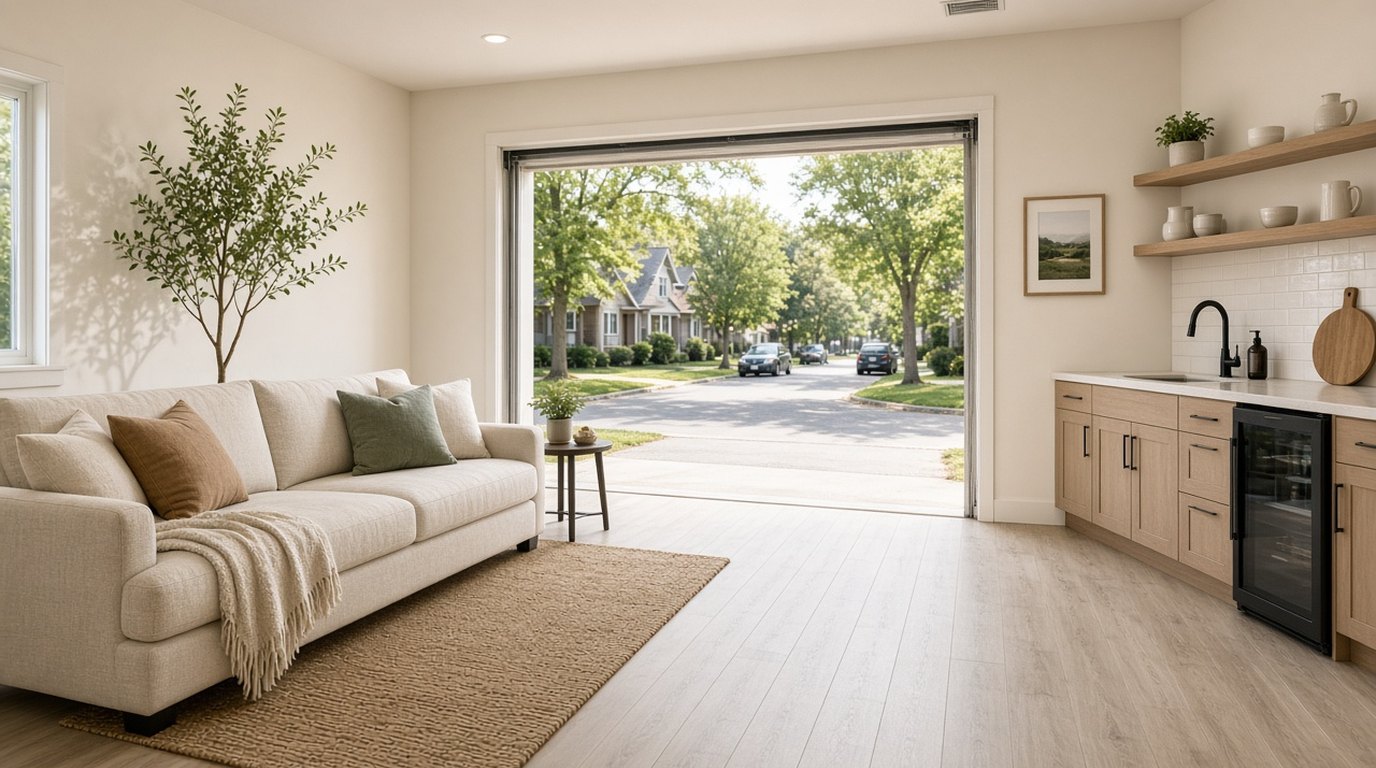
Canadian homeowners have a space problem. Housing costs are at historic highs, families are getting creative with multi-generational living, and remote work has created demand for rooms that didn’t exist five years ago. Meanwhile, most Canadian homes have a 400 to 600 square foot box attached to the house that stores a car, some tools, and years of accumulated stuff.
A garage conversion turns that underused space into something your family actually needs, a rental suite, an in-law apartment, a home office, a studio, or a playroom. It’s significantly cheaper than building an addition and faster than finishing a basement, since the structure already exists.
But converting a garage in Canada isn’t as straightforward as drywalling the walls and laying down flooring. Our climate demands serious insulation, our building codes have specific requirements, and your municipality may have zoning rules you need to navigate.
Is a Garage Conversion Right for You?
Before you start planning, consider these questions:
Where will you park? In most of Canada, parking on the street year-round isn’t practical or legal during winter. If you lose your garage, you need a driveway that’s large enough for your vehicles, or you need to be comfortable scraping frost and clearing snow off a car that lives outside.
Does your municipality allow it? Zoning bylaws vary dramatically. Some cities (Vancouver, Toronto, Edmonton) have actively encouraged garage conversions as part of their affordable housing strategies. Others restrict them or require parking minimums that make conversion impractical. Check your local zoning before investing in plans.
What’s the ceiling height? Habitable space in Canada typically requires a minimum ceiling height of 7 feet (some jurisdictions accept 6’5”). Many garages meet this, but some don’t, especially older homes with lower roof pitches.
Is the slab in good shape? Garage concrete slabs are usually thinner and less reinforced than house foundations. Cracks, heaving, and moisture issues need to be assessed before you build on top.
Conversion Ideas
The Accessory Dwelling Unit (ADU)
An ADU (a self-contained living unit with its own kitchen, bathroom, bedroom, and entrance) is the highest-value garage conversion. It can house aging parents, adult children, or generate rental income.
What’s required:
- Full bathroom (toilet, sink, shower or tub)
- Kitchen with sink, counter space, cooking appliance, and range hood vented to exterior
- Bedroom with egress window meeting fire code
- Separate entrance
- Separate electrical panel (in most jurisdictions)
- Smoke and CO detectors
- Insulation and heating meeting residential building code
Cost: $50,000 to $100,000 for a complete ADU conversion of a two-car garage. Single-car garage conversions run $30,000 to $60,000.
ROI: In markets with strong rental demand, a garage ADU generating $1,000 to $1,800/month recovers its cost in 3 to 6 years while adding significant property value.
The In-Law Suite
Similar to an ADU but often without a full kitchen, a kitchenette with a microwave, mini-fridge, sink, and counter is more common. This works when a family member lives in the space but shares main meals with the household.
Design tips:
- Include a private bathroom, this is non-negotiable for dignity and independence
- Design the entrance to be accessible (no steps, wide doorways, lever handles)
- Include a sitting area separate from the sleeping area
- Ensure good natural light with new windows or an enlarged garage door opening converted to a window wall
- Add a separate thermostat so the occupant controls their own comfort
The Home Studio
Artists, musicians, podcasters, and content creators all need dedicated workspace with specific requirements. A garage conversion offers the space, the sound isolation (especially detached garages), and the separation from the household.
Music/podcast studio:
- Double-wall construction for sound isolation
- Floating floor (decoupled from the concrete slab) to prevent sound transmission
- No parallel walls, angle at least one surface to prevent standing waves
- Dedicated electrical circuits to avoid noise from shared circuits
- HVAC that doesn’t introduce duct noise
Art studio:
- North-facing skylights or windows for consistent, cool light (ideal for colour-accurate work)
- Durable, easy-to-clean flooring (sealed concrete or commercial LVT)
- A utility sink with plumbing for cleanup
- Proper ventilation for paints, solvents, and fixatives
The Home Gym
Garages are natural gym spaces, concrete floors handle heavy equipment, ceiling heights accommodate pull-up bars and overhead presses, and the separation from the house means your family doesn’t feel every dropped weight.
Essentials:
- Rubber flooring over the concrete ($3 to $8/sq ft)
- Insulation and heating (working out in a -30°C garage is not motivating)
- A dedicated 20-amp circuit for a treadmill or other powered equipment
- Ventilation, a ceiling fan and an exhaust fan prevent moisture buildup
- A full-length mirror on at least one wall
- Bright, energizing lighting (4000K to 5000K)
The Workshop
If you’re converting a two-car garage, dedicating half to a workshop and half to living space is a practical compromise. A well-designed workshop includes:
- Workbench with task lighting
- Tool storage (pegboard, cabinets, french cleats)
- Dust collection for power tools
- Proper electrical (multiple 20-amp circuits for tools)
- A concrete or epoxy floor (easy to clean and durable)
The Technical Challenges (and Solutions)
Insulation
A standard Canadian garage has little to no insulation. Converting it to living space requires bringing it up to residential code, which means:
Walls: R-20 minimum in most provinces. 2x6 framing with batt insulation, or 2x4 framing with rigid foam plus batt. Spray foam insulation ($3 to $6/sq ft) is the premium option, it seals air gaps and provides both insulation and vapour barrier.
Ceiling/roof: R-32 to R-50 depending on province. If the garage has an attic space above, blown-in insulation is the most cost-effective. If not, you’ll need spray foam between rafters.
Floor: R-10 minimum. Rigid XPS foam (2 inches) laid over the concrete slab, topped with a subfloor panel and your finished flooring. This raises the floor 3 to 4 inches, which affects your ceiling height calculation.
Garage door opening: The biggest thermal weak point. Options include:
- Framing in the opening with a standard insulated wall (cheapest, most effective thermally)
- Installing a wall of windows or a glass door (more expensive but brings in natural light)
- Keeping the garage door and insulating it (if you want the option to use the space as a garage again, but this option has poor thermal performance)
Heating
A converted garage needs its own heat source. Options:
- Extending the existing HVAC system: If your furnace has spare capacity, adding ductwork to the garage is the most seamless option ($2,000 to $5,000)
- Ductless mini-split: A dedicated heat pump unit ($3,000 to $6,000 installed) provides both heating and cooling. Efficient, quiet, and doesn’t require ductwork
- Electric baseboard heaters: The cheapest to install ($500 to $1,500) but the most expensive to operate in provinces with high electricity rates
- In-floor radiant heating: Luxurious and efficient but expensive to install over an existing slab ($8 to $15/sq ft)
For more on energy-efficient heating options, see our guide on Energy-Efficient Windows for Canada.
Plumbing
If your conversion includes a bathroom or kitchen, plumbing is the most complex technical challenge. The garage slab wasn’t designed for plumbing, which means:
- Trenching into the concrete to run drain lines ($2,000 to $5,000)
- Or building a raised platform floor with plumbing underneath ($3,000 to $8,000)
- Or using an upflush toilet system ($1,500 to $3,000) that pumps waste to the main drain line without trenching
Electrical
Garages typically have one or two circuits. Living space requires:
- A subpanel or dedicated circuits from the main panel
- Multiple outlets on each wall (code requires outlets every 12 feet minimum)
- Dedicated circuits for kitchen appliances, bathroom fans, and HVAC
- Lighting circuits separate from outlet circuits
- Exterior lighting at the new entrance
For flooring options that work well on concrete slabs, see our guide on Sustainable Flooring Options for Prairie Homes.
Check out our Lighting Design Guide for strategies on illuminating spaces with limited natural light.
Permit and Zoning Considerations
Building permits are required for any garage conversion in Canada. This isn’t optional, unpermitted work creates liability, insurance issues, and problems at resale.
Zoning approval may be required separately from building permits, especially if you’re creating a secondary dwelling unit. Many cities require:
- A minimum lot size
- Adequate parking for the remaining household
- Compliance with setback requirements
- Owner occupancy in either the main home or the converted unit
Timeline: Permit approvals vary from 2 weeks to 3 months depending on municipality and complexity. Budget for this in your project timeline.
Budget Planning
| Component | Single-Car Garage | Two-Car Garage |
|---|---|---|
| Insulation and framing | $5,000 to $10,000 | $8,000 to $18,000 |
| Electrical | $3,000 to $6,000 | $5,000 to $10,000 |
| Plumbing (if applicable) | $5,000 to $12,000 | $5,000 to $12,000 |
| HVAC | $3,000 to $6,000 | $4,000 to $8,000 |
| Flooring | $2,000 to $4,000 | $3,000 to $7,000 |
| Drywall and finishing | $3,000 to $6,000 | $5,000 to $10,000 |
| Windows and doors | $2,000 to $5,000 | $3,000 to $8,000 |
| Kitchen (if applicable) | $5,000 to $15,000 | $5,000 to $15,000 |
| Bathroom (if applicable) | $5,000 to $12,000 | $5,000 to $12,000 |
| Total range | $30,000 to $75,000 | $45,000 to $100,000 |
Is It Worth It?
In most Canadian markets, yes. A garage conversion costs $150 to $250 per square foot, significantly less than new construction ($300 to $500/sq ft) and comparable to or cheaper than a basement renovation. The value add depends on what you build: a legal ADU can add $50,000 to $150,000 to property value in markets with strong rental demand.
Even if the value at resale is neutral, the functional benefit (extra living space, rental income, or a dedicated workspace) often justifies the investment.
Considering a garage conversion? Georgia Home Design offers virtual consultations. I’ll help you evaluate your space, navigate design decisions, and plan a conversion that meets your needs and your budget. Book a consultation →